
Stainless Steel Rod / Round Bar: Structural Strength for Years and Years
We typically stock stainless steel rod from 3mm diameter to 70mm (1/8” to 12”). For a full list of metric and imperial sizes, click here. Call us if the size you require is not listed.
Stainless steel rod has numerous uses across a wide variety of industries. From ladder rungs and minimalist door handles to architectural uses such as reinforcing concrete. Stainless steel rod (or stainless steel round bar) can also be threaded so it can be used to securely hold objects together. Since it was first produced, stainless rod has been an essential part of many industrial applications.
IM Grades
The development of Improved Machining (IM) grades, 303, 304/304L and 316/316L, has enhanced the machining process of stainless steel rod allowing it to be used for all manner of components, whilst increased cutting speeds, prolonging tool life and increasing drilling and tapping characteristics. Other grades have been developed for improved hardness via heat treatment and there are also grades that are produced to have superior corrosion qualities, which we have included at the end of this article.
Threaded
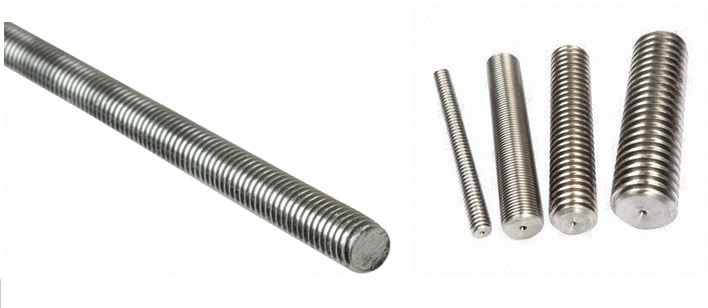
The threads on threaded stainless steel rod can either run very close to each other or be spread apart, depending on requirements and end use. When a stainless steel round bar is threaded you end up with a versatile non-corrosive product which is perfect for marine environments and exterior projects (where the elements would otherwise corrode the rod). Threaded stainless steel rod is also well suited to extreme temperatures when produced in the right grade, such as 321. The other benefits of threaded rod are that it can be cleaned easily, it has an attractive appearance and it is very economical due to its structural longevity.
Because of stainless steel’s non-corrosive attributes, smooth stainless steel rod is used extensively as reinforcing bar (rebar) within concrete. The metal rod lasts for a very long time, even when exposed to corrosive elements such as road salts, sea water and sea air. Stainless steel rod is used in building foundations, bridges including motorway bridges, tunnels, barrier walls and all manner of marine facilities. FACT: tests conducted on stainless steel rod rebar by the US Federal Highway Administration found that it could extend the lifetime of a bridge 75-100 years, owing to its non-corrosive properties.

Below you will find the characteristics and properties of the most popular grades for stainless steel rod / round bar. All of these are available through Metal Supplies™ and can be cur to any length. To see view our standard stock sizes and dimensions, please click here click here:
|
Grade |
Description |
|
303 |
303 grade stainless steel rod has the best machining characteristics of the austenitic stainless steels round bars. It is most commonly used when extensive machining is required during a production process. Grade 303 is available in Improved Machining format which has even better machining characteristics than standard 303. |
|
304 |
304 stainless steel rod grade is dual certified as grade 304 and 304L. Grade 304 is the standard “18/8” stainless steel. It has excellent forming and welding characteristics. Grade 304L is a lower carbon version of 304 and does not require post-weld annealing. It is primarily used in heavy gauge components. 304 is available in Improved Machining grade with machinability significantly higher than that of the standard 304. |
|
316 |
316 grade is dual certified as grade 316 and 316L. 316 stainless steel rod is the standard molybdenum-bearing stainless steel round bar and the second most widely used austenitic stainless steel grade after 304. The molybdenum gives 316 better general corrosion resistance than Grade 304 and higher resistance to pitting and crevice corrosion in chloride environments. It has excellent forming and welding characteristics. 316 is available in Improved Machining grade with machinability significantly higher than that of the standard 316. |
|
321 |
Grade 321 stainless steel rod is similar to 304 but has a lower risk of weld decay thanks to the addition of titanium. Typically used because it is not subject to post-heating (within the carbide precipitation range of 425-850°C), inter-granular corrosion. Grade 321 stainless steel round bar is most popular for uses where the temperature range is anything up to about 900°C. It combines high strength with resistance to scaling and phase stability, particularly where subsequent aqueous corrosive conditions are present. In the annealed condition, the corrosion resistance of Grade 321 is the same as Grade 304. It is superior to 304 stainless for welds that have not been post-weld annealed or if the application involves service at temperatures of 425-900°C. |
|
410 |
Grade 410 stainless steel rod is commonly used for applications requiring good strength, toughness and reasonable corrosion. 410 stainless steel offers good corrosion resistance to atmospheric corrosion, water and some chemicals. Its optimum corrosion resistance is in the hardened and tempered condition and is best achieved by allowing oxygen to circulate freely on the surface which will form an oxide film which protects the steel. |
|
420 |
420 grade stainless steel rod can be hardened by quench-and-temper heat treatment. It contains a minimum of 12 per cent chromium, just sufficient to give corrosion resistance properties. It has good ductility in the annealed condition but is capable of being hardened up to Rockwell Hardness 50HRC, the highest hardness of the 12 per cent chromium grades. Its best corrosion resistance is achieved when the metal is hardened and surface ground or polished. 420 is available in Improved Machining grade with machinability significantly higher than that of the standard 420. |
|
431 |
Grade 431 stainless steel rod is made from a heat treatable martensitic, nickel-bearing grade which has the best corrosion resistance properties of all the martensitic grades. It has excellent tensile and torque strength, and good toughness, making it ideally suited to shafting and bolt applications. It can be hardened to approximately 40HRC. Because of its high yield strength, this grade is not readily cold worked and is therefore not recommended for use in operations such as cold heading, bending, deep drawing or spinning. 431 is available as in Improved Machining grade with machinability significantly higher than that of the standard 431. |


